
Carbon Footprint 2025
Greenhouse Gas Emissions in 2025
Since 2023, the University of Warsaw has been monitoring its carbon footprint in line with the GHG Protocol. This internationally recognized framework enables consistent and comparable reporting of greenhouse gas emissions.
Scope 1 GHG – Direct Emissions
Scope 1 covers direct greenhouse gas emissions resulting from the University’s operations. These include emissions related to:
- the use of heating boilers (stationary fuel combustion),
- fuel combustion in stationary installations for purposes other than heating (e.g. process use),
- fuel combustion in vehicle engines,
- leakage of refrigerants.
Emission data includes all University of Warsaw facilities, both those located in Warsaw and those outside the city. For 2025, the data collection process – particularly for fuel combustion in non-heating stationary installations – was methodologically refined.
Emission calculations for fuel combustion were based on emission factors published by the National Centre for Emissions Management (KOBiZE). Emissions related to refrigerant leakage were calculated using Global Warming Potential (GWP) values published by the Intergovernmental Panel on Climate Change (IPCC).
The carbon footprint for Scope 1 amounted to approximately 1.3 thousand tonnes of CO₂ equivalent (tCO₂e), with stationary fuel combustion identified as the primary source of emissions.
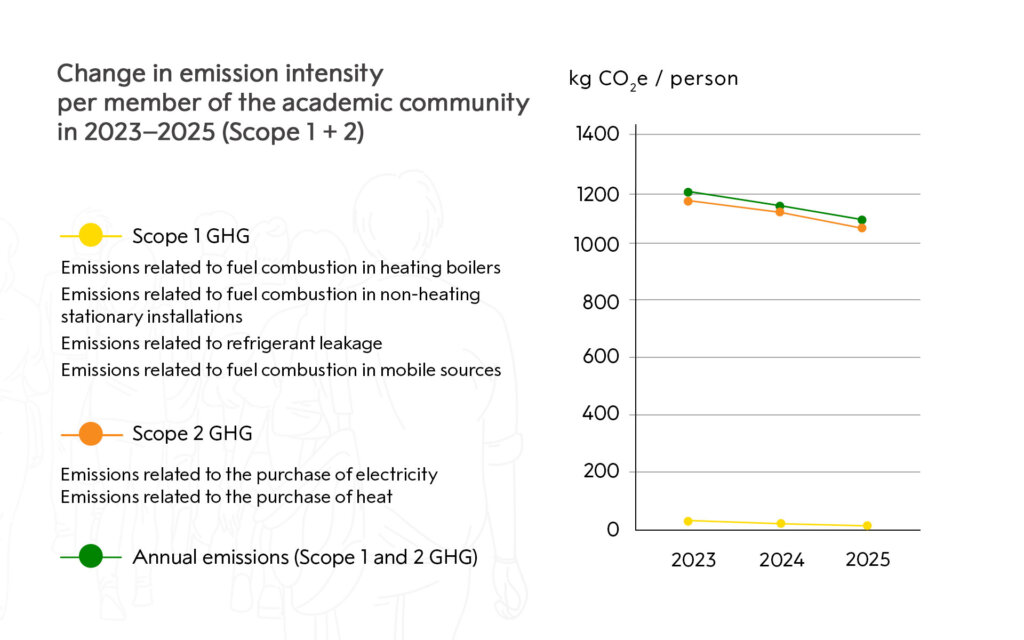
Emission intensity:
- 27.3 kg CO₂e per person (based on the total number of students and doctoral students – with each individual counted only once), as well as the number of employees (measured in full-time equivalents),
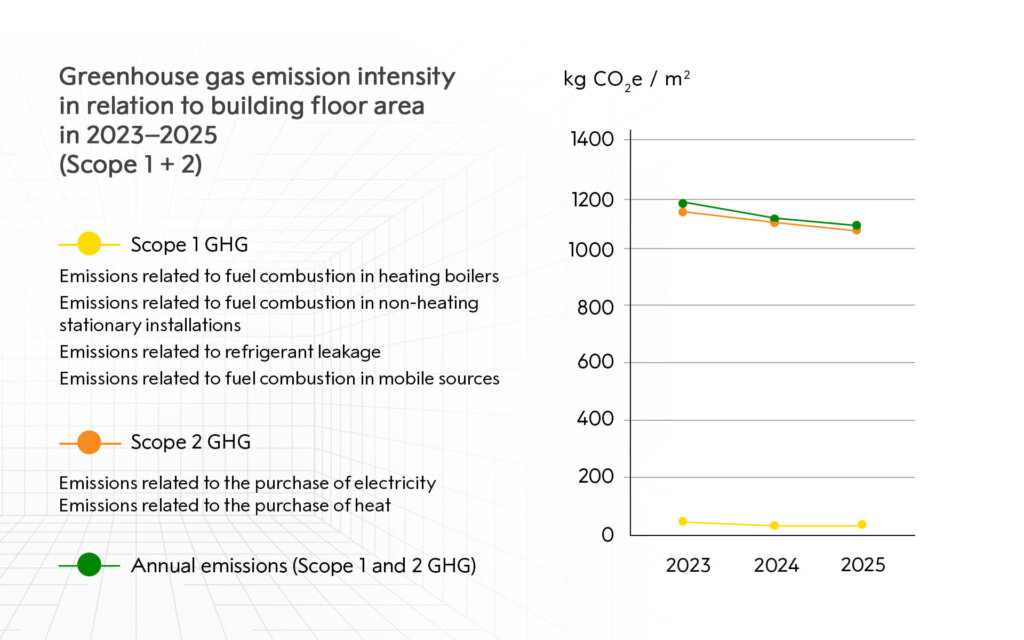
- 2.3 kg CO₂e per square meter of building floor area.
Scope 2 GHG – Indirect Emissions from Purchased Energy
Scope 2 covers indirect greenhouse gas emissions resulting from the University’s operations. These include emissions associated with:
- the purchase of electricity,
- the purchase of heat (district heating).
Data on electricity consumption covers all University of Warsaw facilities across Poland. In contrast, data on heat purchases applies to buildings located in Warsaw. Emissions related to heat generation in facilities outside Warsaw were accounted for under Scope 1 (stationary fuel combustion) or under Scope 2 as part of electricity consumption, where electricity was used to generate heat.
The calculations were based on both location-based emission factors (national averages) and market-based emission factors published by electricity and heat suppliers.
The Scope 2 carbon footprint amounted to:
- 48.9 thousand tCO₂e (location-based),
- 49.0 thousand tCO₂e (market-based).
Emission intensity (location-based):
- 1,039.3 kg CO₂e per person,
- 88.0 kg CO₂e per square meter of floor area.
Total Greenhouse Gas Emissions
In 2025, the University’s total greenhouse gas emissions (Scopes 1 and 2) amounted to 50.2 thousand tCO₂e. The primary source of environmental impact remained indirect emissions (Scope 2), resulting from the purchase of electricity and district heating.
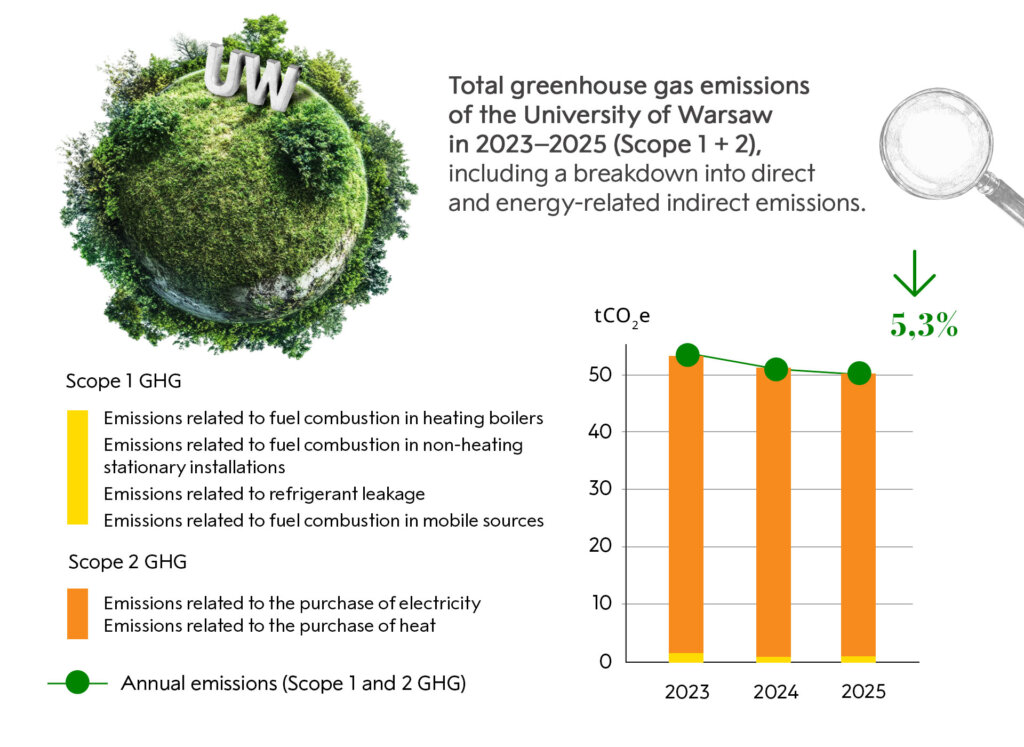
Compared to the base year 2023, the total carbon footprint decreased by 5.3%. However, it is important to note that the University of Warsaw is a dynamically developing institution – both in terms of the size of its academic community and the expansion of its campus infrastructure. For this reason, emission intensity indicators provide a more meaningful measure of progress. The carbon footprint per member of the academic community amounted to 1,067 kg CO₂e, representing a decrease of nearly 11.5% compared to the base year. In relation to building floor area, the carbon footprint reached 90 kg CO₂e/m², reflecting a reduction of 8.2%. While the total emissions reduction was 5.3%, the improvement in efficiency is significantly more pronounced when measured on a per-unit basis.
The reduction in the University’s carbon footprint is the result of consistent infrastructure upgrades, including building thermal retrofits, the phase-out of high-emission local heat sources, the development of renewable energy installations (RES), and the optimization of cooling systems, including the implementation of free-cooling technology.